.png)
Restoration Journal Week 2

During the second week, I began studying Buddhist iconography. I mainly focused on the study of visual characteristics of Song-dynasty Buddhist statues.
What are the most distinctive features of Song Buddhist sculpture? They can often be found in the drapery of the clothing, the use of color, and the overall form of the figure. However, much of this work still depends on careful visual comparison. We must examine surviving Song-dynasty paintings and Buddhist sculptures, then compare their stylistic features---examples such as the Dazu Rock Carvings in Chongqing.

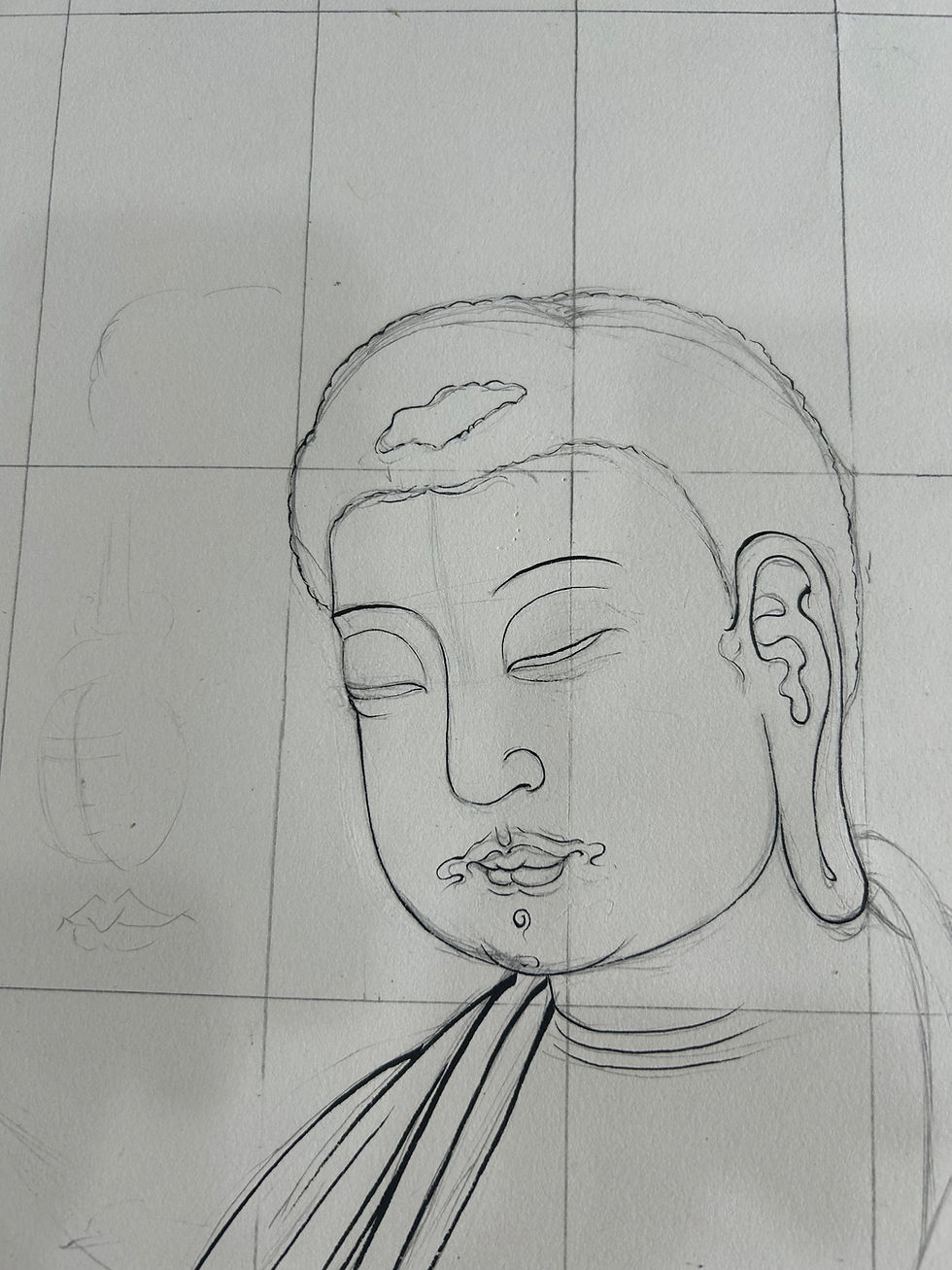
The modeling of the face, known as kailian—literally “opening the face”—is especially important and often reflects a specific historical period. Ming-dynasty Buddhist figures tend to have smaller and more elaborate facial features, oval faces, and refined, delicate features. Song-dynasty sculptures, by contrast, often feel more human and natural. They reflect accumulated artistic experience and a stronger attention to the body.
From my perspective, color may be one of the clearest differences. Ming Buddhist sculpture often includes vivid and bright blue pigments, while Song-dynasty sculpture generally appears more restrained, balanced, and realistic. The treatment of musculature is often more natural and convincing, which can become a distinctive feature of the period.
When colors overlap across different periods, however, identification can no longer depend on pigment alone. At that point, one must judge the overall “flavor” or spirit of the work. For example, Southern Song art often carries the atmosphere of the literati tradition.

This is related to the cultural and historical background of the period: its elegance, reserve, compositional structure, and quiet character create a different visual atmosphere.
Every person has a unique way of regulating emotion and thinking, and this can affect the form of the body, the movement of the muscles, and even the energy of the brushstroke. In the same way, Buddhist sculpture from different periods carries its own rhythm, temperament, and spiritual atmosphere.